What Is the Waist-to-Hip Ratio?
The waist-to-hip ratio (WHR) is a simple measurement that compares the circumference of your waist to the circumference of your hips:
WHR = waist circumference / hip circumference
Because it does not require height or weight, WHR is one of the quickest ways to assess where body fat is distributed. Research consistently links a higher WHR — indicating more fat stored around the abdomen — to an increased risk of cardiovascular disease, type 2 diabetes, and other metabolic conditions.
How to Measure Correctly
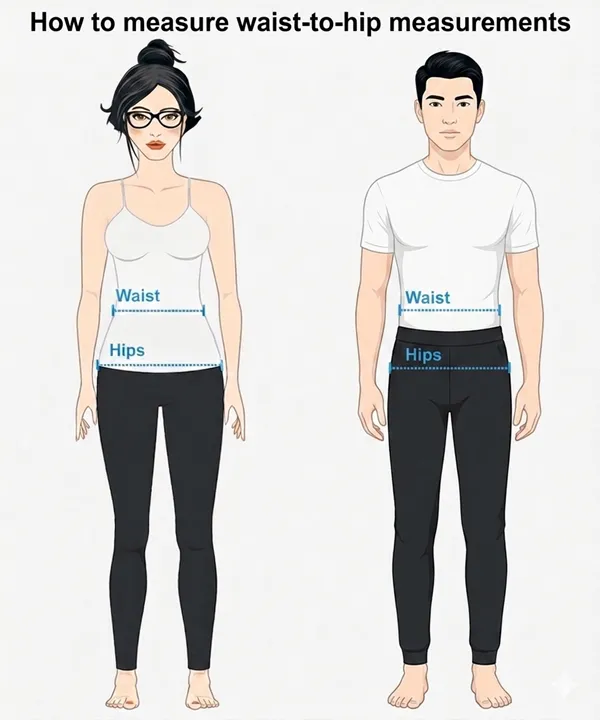
Waist — measure around the narrowest part of your torso, usually just above the belly button and below the lowest rib. Stand relaxed, breathe out gently, and measure at the end of a normal exhale. Do not pull your stomach in.
Hips — measure around the widest point of your hips and buttocks, with feet together. Keep the tape horizontal and snug against the skin without compressing it.
Use the same unit for both measurements (cm or in) — the ratio will be identical either way.
Interpreting Your Result
The World Health Organization defines the following risk categories based on sex:
| Category | Women | Men |
|---|---|---|
| Low risk | < 0.80 | < 0.90 |
| Moderate risk | 0.80 – 0.84 | 0.90 – 0.99 |
| High risk | ≥ 0.85 | ≥ 1.00 |
These thresholds reflect typical differences in fat distribution between the sexes. Women naturally store more fat in the hips and thighs, which is why the boundaries are set lower.
Why WHR Matters
Where fat is stored in the body significantly affects health — often more than the total amount of fat. Fat deposited around the abdomen (visceral fat) is metabolically active and releases inflammatory substances that can damage blood vessels, impair insulin sensitivity, and raise blood pressure.
People with a high WHR — sometimes described as having an “apple-shaped” body — tend to carry more visceral fat and face a higher risk of:
- Cardiovascular disease — including heart attack and stroke
- Type 2 diabetes — linked to insulin resistance from visceral fat
- Hypertension — elevated blood pressure
- Sleep apnea and certain cancers
People with a low WHR — a “pear-shaped” pattern where fat is stored in the hips and thighs — have a relatively lower risk profile for these conditions.
WHR vs BMI
BMI (body mass index) calculates weight relative to height. It is a useful population-level screening tool but cannot distinguish between fat and muscle and gives no information about where fat is located.
WHR addresses this blind spot directly. Two people with the same BMI can have very different WHR values — and therefore very different health risk profiles. Studies have found WHR to be a stronger predictor of cardiovascular outcomes and mortality than BMI alone.
Neither metric tells the whole story. WHR does not capture overall body fat percentage or muscle mass. For the most accurate assessment, WHR and BMI are best considered together and in consultation with a healthcare professional.
Sources
- World Health Organization. Waist Circumference and Waist–Hip Ratio: Report of a WHO Expert Consultation. Geneva, 2008.
- Healthline. Apple Body Shape.
- Harvard Health Blog. The link between abdominal fat and death: what is the shape of health?.