How to Measure Ring Size
Method 1 — Measure an Existing Ring
Take a ring that already fits the intended finger well. Measure the inside diameter — the straight distance across the inner circle from one inside edge to the other. A ruler or digital calipers works best.
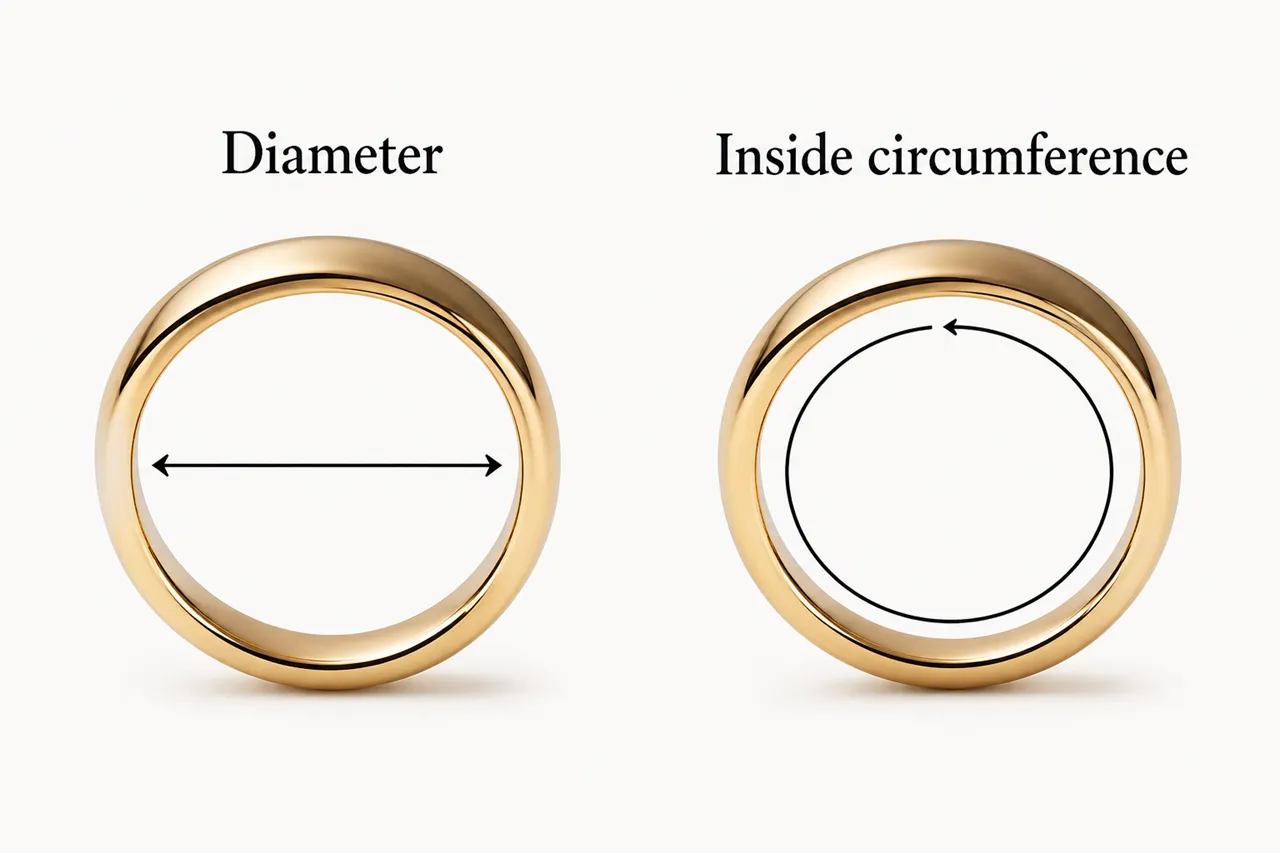
Enter this measurement into the calculator above as the Inside Diameter. The calculator automatically computes the circumference and shows your size in all major international systems.
Method 2 — Measure Your Finger
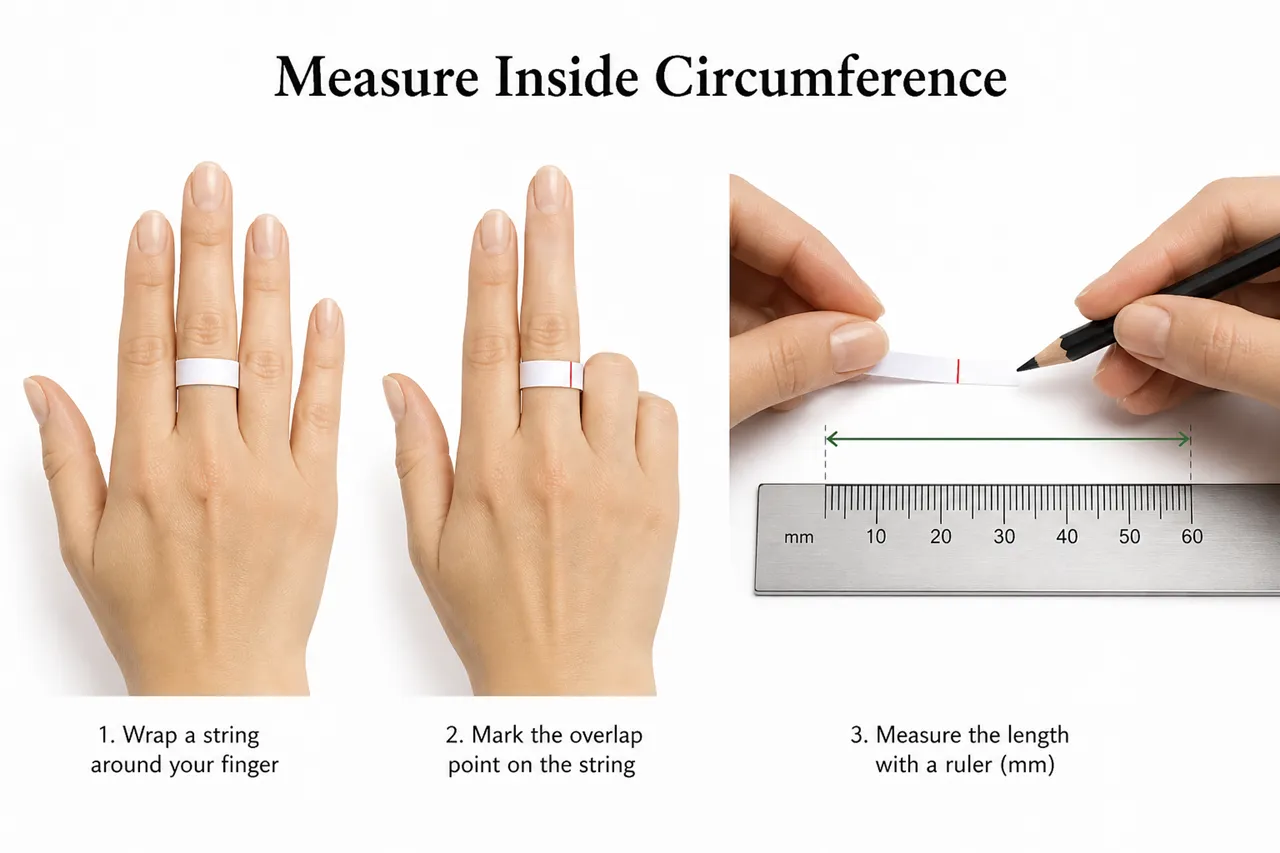
- Wrap a thin strip of paper or a flexible measuring tape around the base of your finger. It should be snug but not tight — you should be able to slide it over your knuckle with slight resistance.
- Mark the point where the strip overlaps. A fine pen works better than pencil for a precise mark.
- Measure the length from the end of the strip to the mark in millimetres. This is your inside circumference.
Tips for accurate measurement: Measure at the end of the day when your hands are warm. Avoid string or elastic — they stretch. A narrow strip of printer paper (about 5 mm wide) works best. Measure 2–3 times and average the results.
Ring Size Conversion Charts
USA / Canada Ring Sizes
| Inside Diameter (mm) | Inside Circumference (mm) | US / CA Size |
|---|---|---|
| 14.1 | 44.2 | 3 |
| 14.5 | 45.5 | 3½ |
| 14.9 | 46.8 | 4 |
| 15.3 | 48.0 | 4½ |
| 15.7 | 49.3 | 5 |
| 16.1 | 50.6 | 5½ |
| 16.5 | 51.9 | 6 |
| 16.9 | 53.1 | 6½ |
| 17.3 | 54.4 | 7 |
| 17.7 | 55.7 | 7½ |
| 18.1 | 57.0 | 8 |
| 18.5 | 58.2 | 8½ |
| 19.0 | 59.6 | 9 |
| 19.4 | 60.9 | 9½ |
| 19.8 | 62.2 | 10 |
| 20.2 | 63.5 | 10½ |
| 20.6 | 64.8 | 11 |
| 21.0 | 66.0 | 11½ |
| 21.4 | 67.3 | 12 |
| 21.8 | 68.5 | 12½ |
| 22.2 | 69.8 | 13 |
Each full US size increases the inside diameter by 0.8128 mm (or circumference by 2.55 mm). Quarter sizes (¼, ½, ¾) are standard in jewelry stores.
UK / Australia Ring Sizes
| Inside Circumference (mm) | UK / AU Size | Inside Circumference (mm) | UK / AU Size |
|---|---|---|---|
| 40.0 | C | 53.1 | M½ |
| 40.6 | C½ | 53.8 | N |
| 41.3 | D | 54.4 | N½ |
| 41.9 | D½ | 55.0 | O |
| 42.5 | E | 55.6 | O½ |
| 43.1 | E½ | 56.3 | P |
| 43.8 | F | 56.9 | P½ |
| 44.4 | F½ | 57.5 | Q |
| 45.0 | G | 58.1 | Q½ |
| 45.6 | G½ | 58.8 | R |
| 46.3 | H | 59.4 | R½ |
| 46.9 | H½ | 60.0 | S |
| 47.5 | I | 60.6 | S½ |
| 48.1 | I½ | 61.3 | T |
| 48.8 | J | 61.9 | T½ |
| 49.4 | J½ | 62.5 | U |
| 50.0 | K | 63.1 | U½ |
| 50.6 | K½ | 63.8 | V |
| 51.3 | L | 64.4 | V½ |
| 51.9 | L½ | 65.0 | W |
| 52.5 | M |
Each half-letter step adds 0.625 mm to the inside circumference. UK size C equals 40.0 mm inside circumference.
International Ring Size Comparison
| Diam (mm) | US / CA | UK / AU | EU / ISO | Germany | Japan | India |
|---|---|---|---|---|---|---|
| 14.9 | 4 | H½ | 47 | 15.0 | 7 | 7 |
| 15.3 | 4½ | I | 48 | 15.5 | 8 | 7 |
| 15.7 | 5 | J½ | 49 | 15.5 | 9 | 8 |
| 16.1 | 5½ | K | 51 | 16.0 | 10 | 9 |
| 16.5 | 6 | L½ | 52 | 16.5 | 11 | 10 |
| 16.9 | 6½ | M½ | 53 | 17.0 | 12 | 11 |
| 17.3 | 7 | N½ | 54 | 17.5 | 13 | 12 |
| 17.7 | 7½ | O½ | 56 | 17.5 | 14 | 13 |
| 18.1 | 8 | P½ | 57 | 18.0 | 15 | 14 |
| 18.5 | 8½ | Q½ | 58 | 18.5 | 16 | 15 |
| 19.0 | 9 | S | 60 | 19.0 | 18 | 17 |
| 19.4 | 9½ | T | 61 | 19.5 | 19 | 18 |
| 19.8 | 10 | U | 62 | 20.0 | 20 | 19 |
| 20.2 | 10½ | V | 63 | 20.0 | 21 | 20 |
| 20.6 | 11 | W | 65 | 20.5 | 22 | 21 |
| 21.0 | 11½ | X½ | 66 | 21.0 | 23 | 22 |
| 21.4 | 12 | Y | 67 | 21.5 | 24 | 23 |
| 21.8 | 12½ | Z | 68 | 22.0 | 25 | 24 |
| 22.2 | 13 | Z+1 | 70 | 22.0 | 27 | 26 |
These conversions follow ISO 8653:2016 and BS 6820:1987 standards. Slight variations (up to 0.5 mm) exist between manufacturers.
A note on sizing accuracy: Ring sizing standards vary slightly between countries and even between jewelers within the same country. The values in this calculator and charts are based on international standards. For the most accurate fit, always try on a ring in person or use a professional ring sizer. A ring that is slightly too large can be resized down by most jewelers; a ring that is too small is harder to adjust.